Build the Data Centers
1,371 words · 7 min read
Disclaimer: This post reflects my personal views and does not represent the views of my employer or my community.
Caveat: This was written with research assistance from AI tools, but I curated the content, edited the draft, and cross-checked the references.
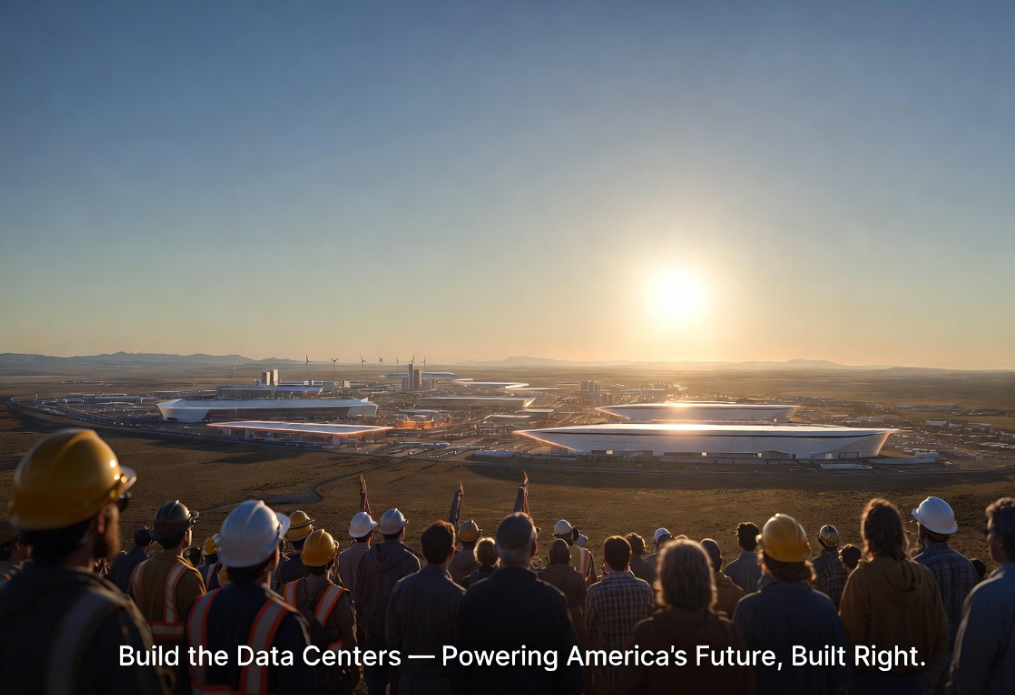
Image: The illustration above was generated with Grok.
AI data centers are changing the American economy in big ways right now. We should support building more of them, not fewer.
In west Texas, there is a building the size of several football fields. It runs all day, uses more than a gigawatt of power, and holds millions of computer chips. Not long ago, this was just ranchland. Now, it is one of many new sites across the country helping to power the AI economy.
During the first half of 2025, spending on computers, software, and data centers made up about 92 percent of US economic growth [1]. Although this sector is only about 4 percent of GDP, the St. Louis Fed found it still made up nearly 39 percent of real growth in the first nine months [2]. However you look at it, this expansion is helping keep the country moving forward.
These data centers are more than just large buildings filled with machines. They are the foundation of the next economy. The computing power inside supports new medicines, scientific discoveries, better logistics, and helps many small businesses. People are already seeing these benefits in their paychecks.
These jobs are real; I am living proof of this American experiment. One study found that building data centers supports over 571,000 jobs and brings in almost 18 billion dollars in tax revenue each year [3]. Workers at these sites can earn up to 30 percent more [4], and an electrician’s union near Washington has doubled in size since 2018 [5]. Wherever these centers are built, tax money follows. In Loudoun County, Virginia, data centers now provide nearly half of the property taxes that fund schools, police, and roads [6].
I don’t believe data centers provide many permanent jobs. Once a data center is finished, it might employ only a few hundred people. Anyone who says they are a permanent jobs engine is exaggerating. The real value comes from the years of construction, the expanded tax base, and the lasting improvements to the grid and fiber networks.
This is where I see things differently from most reports or doomsday blogs. The concerns are real, but they are not reasons to stop building. We should never stop progress, because progress defines American ingenuity. Instead, these concerns are reasons to build in a smarter way.
These concerns are real. Some households are already paying higher bills because of data center demand, about 1.4 billion dollars more each year according to one estimate [7]. Data centers made up about 40 percent of the increase in electricity demand, and prices rose nearly 7 percent in 2025 [8]. For example, a brick maker in Ohio saw its monthly power bill jump from 1,600 dollars to 12,000 [9]. Utilities requested a record 31 billion dollars in rate hikes last year [10]. Water use is also a concern. US data centers used about 264 billion gallons of water in 2025, much of it in dry regions [11]. Berkeley Lab estimates they could use almost 12 percent of the country’s power by 2030 [12].
People are understandably nervous, and the polls reflect this. Gallup found that 71 percent of Americans do not want a data center built nearby [13], and a Reuters poll showed 77 percent are worried about their electric bills [14]. This is not about being against technology. It is a fair question: will this cost me more? If you tell someone whose bill just tripled that “the future is worth it,” you have already lost their support. That is how something positive can turn into a conflict.
But I am optimistic, and my confidence comes from history. We have built large, intimidating infrastructure before, and it worked out. Railroads once upset many by cutting through farmland, but they eventually connected the country. Electricity was disorganized and skipped rural areas until the government stepped in, and a study found that early electrification brought the biggest wage gains to the lowest-paid workers [15]. The internet was once dismissed as hype, but it ended up driving about a fifth of economic growth in wealthy countries over five years [16]. McKinsey reviewed the data and found that in every decade of US history, higher productivity and more jobs have gone hand in hand [17].
Let us be honest about the history lesson here. We should not just relax and assume things will work out. Progress did not happen on its own. It happened because people set rules about who pays and who benefits. When railroads had no rules, they became monopolies. Electricity reached everyone only because policy required it. The towns that did well made sure the expansion served their needs. We need to take the same approach now.
Let’s look at an example of a company getting it mostly right: Oracle. To be transparent, I work for them, so please keep that in mind. In Doña Ana County, New Mexico, locals were concerned the project would use too much water and power without giving much back. Oracle listened and nearly doubled the number of permanent jobs promised, raising it to about 1,500 [18]. They committed 360 million dollars for county schools and roads, plus 50 million to improve the local water system [19]. Oracle also changed its power plan, replacing gas turbines with a fuel cell system that cuts a major pollutant by about 92 percent and uses much less water [20]. It is not perfect. The system still uses some gas, so it is not completely clean. These are promises, not finished projects, so they should be held accountable. But this is what doing it right looks like. Oracle also aims for all its custom AI centers to be carbon-free by 2035 [21].
New Mexico is not the only place seeing this kind of investment. Oracle is making similar commitments in other towns: 30 million dollars a year for schools and emergency services in Abilene, Texas; 175 million for infrastructure and water in Port Washington, Wisconsin; and over 100 million in taxes plus college scholarships in Shackelford County, which has about 3,200 people [22]. Many of these jobs do not require a college degree, and they are training veterans and high school graduates to fill them [22]. Their cooling systems are closed-loop, so after the initial fill, they use very little of the town’s water [22]. One Oracle executive said AI should be built by and for the communities where it is located, and so far, their spending shows they mean it [22]. This brings me to the part I care about most. Government should not try to stop this. Blocking the future is the worst move possible. But letting it happen with no rules at all is almost as bad. The job is to guide the process, so we build more of these, faster, and build them fairly.
The rule should be simple. If your data center needs a new power line or plant, you should pay for it, not the families living nearby. Companies should sign long-term contracts and provide the funding, so if their demand does not materialize, the public is not left with the bill. Some companies are already moving in this direction. In 2026, seven major tech firms, including Oracle, signed a White House pledge to supply their own power and cover their share of grid costs [23]. But a pledge is just a promise. There are real bills in Congress, like the bipartisan Ratepayer Protection Act [24] and the tougher GRID Act, sponsored by both a Republican and a Democrat [25], that would make this rule a law. Congress should pass the stronger version. As one congressman said, America needs to win the AI race, but working families should not have to pay Big Tech’s power bill [26].
This expansion is happening no matter what, because the economics have already decided. The real question is whose terms it will happen on. We could end up with the worst outcome: private companies profit while the public pays, and towns that host these centers get nothing in return. Or we can choose the best path: build quickly, build fairly, and make sure the communities hosting these data centers benefit. We have faced choices like this before, and we know which way works. Let’s build, and let’s do it right.
References
[1] “Data Center Investment Drives US Economic Growth,” AI Data Analytics Network. https://www.aidataanalytics.network/data-science-ai/news-trends/data-center-investment-drives-us-economy-growth
[2] “Tracking AI’s Contribution to GDP Growth,” Federal Reserve Bank of St. Louis, Jan 2026. https://www.stlouisfed.org/on-the-economy/2026/jan/tracking-ai-contribution-gdp-growth
[3] “The Economic Impact of US Data Center Construction,” Zenith Economics, 2025. https://www.zenithecon.com/publications/datacentereconomicimpact
[4] “Construction Workers Are Earning Six-Figure Salaries in the Data Center Boom,” Fortune, Dec 2025. https://fortune.com/2025/12/05/construction-workers-earning-six-figure-salaries-data-center-boom-ai-tech/
[5] “Construction Industry Facing Worker Shortage Driven by Growth of Data Centers,” ITIF, Jan 2026. https://itif.org/publications/2026/01/12/construction-industry-facing-worker-shortage-driven-by-growth-of-data-centers/
[6] “Data Center Toolkit,” Consumer Energy Alliance, Oct 2025. https://consumerenergyalliance.org/cms/wp-content/uploads/2025/10/CEA-FL_Data-Center-Toolkit.pdf
[7] “AI and Energy,” Allianz Research, May 2026. https://www.allianz.com/content/dam/onemarketing/azcom/Allianz_com/economic-research/publications/specials/en/2026/may/2026-05-12-ai-energy-AZ.pdf
[8] “Electricity Prices, Data Centers, AI and Inflation,” CNBC (Goldman Sachs), Feb 2026. https://www.cnbc.com/2026/02/12/electricity-price-data-center-ai-inflation-goldman.html
[9] “Big Tech Data Centers Are Driving Up Power Bills for America’s Rust Belt Factories,” Reuters, Jul 2026. https://www.reuters.com/business/energy/big-tech-data-centers-are-driving-up-power-bills-americas-rust-belt-factories-2026-07-07/
[10] “Record Utility Rate-Hike Requests Hit $31 Billion,” Fortune, Jan 2026. https://fortune.com/2026/01/29/record-utility-rate-hike-requests-31-billion-public-outcries/
[11] “AI Data Centers’ Water Consumption Breaks 264 Billion Gallons in 2025,” Barchart. https://www.barchart.com/story/news/2339834/ai-data-centers-water-consumption-breaks-264-billion-gallons-in-2025-as-devastating-drought-hits-nearly-63-of-u-s
[12] “United States Data Center Energy Usage Report,” Lawrence Berkeley National Laboratory, 2026. https://eta-publications.lbl.gov/publications/united-states-data-center-energy-2025
[13] “Americans Oppose Data Centers in Their Area,” Gallup, May 2026. https://news.gallup.com/poll/709772/americans-oppose-data-centers-area.aspx
[14] “Americans Wary of AI-Driven Data Center Boom, Reuters/Ipsos Poll Shows,” Reuters, Jun 2026. https://www.reuters.com/world/us/americans-wary-ai-driven-data-center-boom-reutersipsos-poll-shows-2026-06-11/
[15] “Electricity and Labor Market Outcomes,” Uppsala University. https://uu.diva-portal.org/smash/get/diva2:2005675/FULLTEXT01.pdf
[16] “The Great Transformer: The Impact of the Internet on Economic Growth,” McKinsey Global Institute. https://www.mckinsey.com/~/media/mckinsey/industries/technology%20media%20and%20telecommunications/high%20tech/our%20insights/the%20great%20transformer/mgi_impact_of_internet_on_economic_growth.pdf
[17] “Automation and the Future of Work,” McKinsey Global Institute. https://www.mckinsey.com/mgi/media-center/automation-and-the-future-of-work
[18] “Oracle Boosts Data Center Job Forecast After Local Opposition,” Bloomberg, Jan 2026. https://www.bloomberg.com/news/articles/2026-01-26/oracle-boosts-data-center-job-forecast-after-local-opposition
[19] “Oracle Advances American AI Innovation in New Mexico,” Oracle, Jan 2026. https://www.oracle.com/news/announcement/blog/oracle-advances-american-ai-innovation-in-new-mexico-2026-01-23/
[20] “We’ve Overhauled Project Jupiter’s Power Plan,” Oracle, Jul 2026. https://www.oracle.com/news/announcement/blog/weve-overhauled-project-jupiters-power-plan-2026-07-01/
[21] “Oracle Social Impact: Planet,” Oracle. https://www.oracle.com/social-impact/planet/
[22] “Oracle’s Commitment to Data Center Communities,” Oracle (LinkedIn). https://www.linkedin.com/pulse/oracles-commitment-data-center-communities-oracle-fqloe/
[23] “Ratepayer Protection Pledge,” The White House, Mar 2026. https://www.whitehouse.gov/releases/2026/03/ratepayer-protection-pledge/
[24] “Castor Introduces Ratepayer Protection Act,” Rep. Kathy Castor. https://castor.house.gov/news/documentsingle.aspx?DocumentID=405231
[25] “GRID Act (S. 3852),” GovInfo. https://www.govinfo.gov/content/pkg/BILLS-119s3852is/html/BILLS-119s3852is.htm
[26] “Baumgartner Introduces Bill Aiming to Facilitate Responsible Development of AI Data Centers,” Rep. Michael Baumgartner, Jun 2026. https://baumgartner.house.gov/2026/06/25/baumgartner-introduces-bill-aiming-to-facilitate-responsible-development-of-ai-data-centers/